Put the Phone Down and Let the Falls Fix You: Victoria Falls as the Ultimate Digital Detox
You already know the feeling. You wake up and reach for your phone before your eyes are fully open. You scroll through breakfast, half-listen to a podcast on the commute, and spend eight hours staring at a screen at work — only to come home and stare at a different screen. By the time you finally close your eyes at night, your brain is buzzing like a server room that never shuts down.
America is in the middle of a quiet mental health crisis that most of us are too distracted to notice. According to data from the American Psychological Association, nearly a third of U.S. adults report feeling overwhelmed by the sheer volume of information they consume daily. We've built a world that never stops demanding our attention, and our nervous systems are paying the price.
So what's the fix? A weekend off the grid in the Catskills? A social media detox challenge that lasts exactly four days before you're back on Instagram? Or maybe — just maybe — something so enormous, so viscerally overwhelming, and so completely analog that your brain has no choice but to let go?
Welcome to Victoria Falls.
Why Ordinary Vacations Don't Cut It Anymore
Here's the thing about most American vacations: we bring the problem with us. We document every meal, post every sunset, and check emails from the pool. A beach resort in Florida or a ski trip to Colorado doesn't create enough separation from the rhythms of daily life. The WiFi is too good. The habits are too ingrained.
Researchers who study what's sometimes called "attention restoration theory" — a framework developed by environmental psychologists Rachel and Stephen Kaplan — argue that true mental recovery requires immersion in environments that are genuinely different from the ones causing the fatigue. Not just quieter. Actually different. Environments that engage our senses without demanding cognitive effort.
Nature, especially dramatic nature, fits that description almost perfectly. And few places on earth are more dramatically natural than Victoria Falls.
What Happens to Your Brain at the Falls
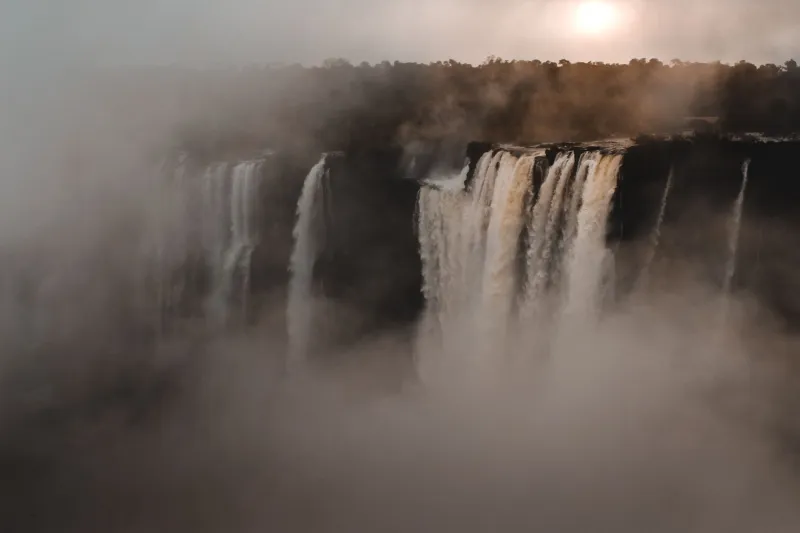
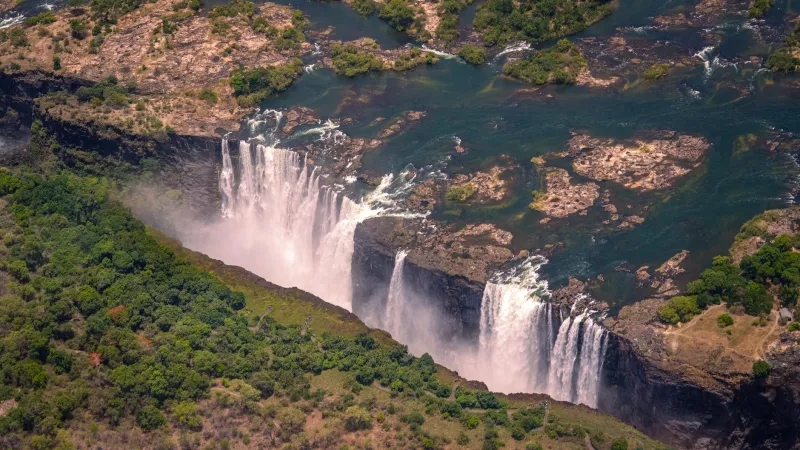
Stand at the edge of Mosi-oa-Tunya — the Toka Leya name that translates to "The Smoke That Thunders" — and something shifts almost immediately. The sound alone is staggering. The falls generate a roar that can be heard from 25 miles away, a low-frequency rumble that doesn't just fill your ears but vibrates through your chest. The mist rises hundreds of feet into the air. The sheer scale — over a mile wide, plunging more than 350 feet — defies easy comprehension.
Neuroscientists who study sensory environments note that exposure to natural stimuli at this intensity can trigger a measurable shift in the brain's default mode network, the system that activates when we're ruminating, worrying, or cycling through to-do lists. "When you're confronted with something that genuinely demands your full sensory attention," explains Dr. Maya Osei, a cognitive neuroscientist who has studied nature-based interventions, "the brain's ruminative circuits quiet down. You're not thinking about your inbox. You're just there."
That state — sometimes called "soft fascination" in the research literature — is exactly what overstimulated brains need most. Unlike the hard, effortful attention required by screens, natural environments invite the mind to wander and recover simultaneously.
Real People, Real Resets
Ask anyone who's made the trip and you'll hear a version of the same story.
Jessica, a 34-year-old marketing director from Austin, Texas, spent seven days at Victoria Falls after what she describes as "the worst burnout of my career." She'd been averaging 11-hour workdays, sleeping poorly, and scrolling through her phone even during meals. "I honestly didn't think a trip was going to fix anything," she admits. "I figured I'd just bring my stress with me to a different time zone."
What she didn't anticipate was the falls themselves. "The first morning I stood at the main viewpoint and I just started crying. Not in a sad way — more like something just released. I couldn't have told you what I was feeling. I just knew I wasn't thinking about work."
By day three, she'd stopped checking her phone for hours at a stretch. By day five, she was sleeping through the night for the first time in months.
Marcus, a software engineer from Seattle, had a similar experience. "I'm someone who literally builds apps for a living. I live in my phone. But there's something about the falls that makes your phone feel completely beside the point. Like, what are you going to post? No photo captures it. No caption does it justice. You just have to be there."
That sense of the ineffable — the feeling that the experience exceeds what any screen can contain — is part of what makes Victoria Falls uniquely powerful as a detox destination. It doesn't just pull you away from technology. It actively makes technology feel inadequate.
How to Plan a Detox-Focused Trip to Victoria Falls
If you're serious about using this trip as a genuine reset, a little intentionality goes a long way.
Choose accommodations that lean into the natural setting. Lodges and camps along the Zambezi River that offer open-air designs, outdoor sleeping options, and limited WiFi create the right conditions for disconnection. The goal is to fall asleep to the sound of the river, not the glow of a TV.
Build in unstructured time. It's tempting to pack every hour with activities — and there's no shortage of incredible ones at Victoria Falls, from white-water rafting to sunset cruises. But leave gaps. Sit by the water. Watch the light change on the gorge. Let boredom happen. Boredom, it turns out, is where the brain starts to heal.
Set a phone protocol before you leave home. Tell your contacts you'll be largely unreachable. Enable out-of-office responses. Delete social media apps for the duration of the trip — you can always reinstall them when you get home. The first 24 hours of disconnection are the hardest; after that, most travelers report that the urge fades dramatically.
Lean into the activities that require full physical presence. A gorge swing, a guided walk through the rainforest mist, a mokoro canoe trip — these aren't experiences you can half-experience while checking notifications. They demand everything you've got, and they give everything back.
The Falls Don't Care About Your Follower Count
There's something almost rebellious about Victoria Falls in the attention economy era. It has existed for millions of years. It will exist for millions more. It doesn't need your engagement, your rating, or your content. It just is — thunderously, magnificently, overwhelmingly present.
And maybe that's exactly what so many of us need right now. Not another productivity hack or wellness app, but an encounter with something so real and so vast that it makes the digital noise feel, at least for a while, completely irrelevant.
Your couch and your screens will be waiting when you get back. The falls are calling now.