Before and After the Falls: Why So Many Travelers Come Home Completely Different People
Photo: P. C. Skovgaard, Public domain, via Wikimedia Commons
There's a joke that floats around Victoria Falls travel forums: Don't go unless you're ready for your life to change. People type it like a warning. But spend any time talking to repeat visitors, and you start to realize it's less of a joke and more of a pattern.
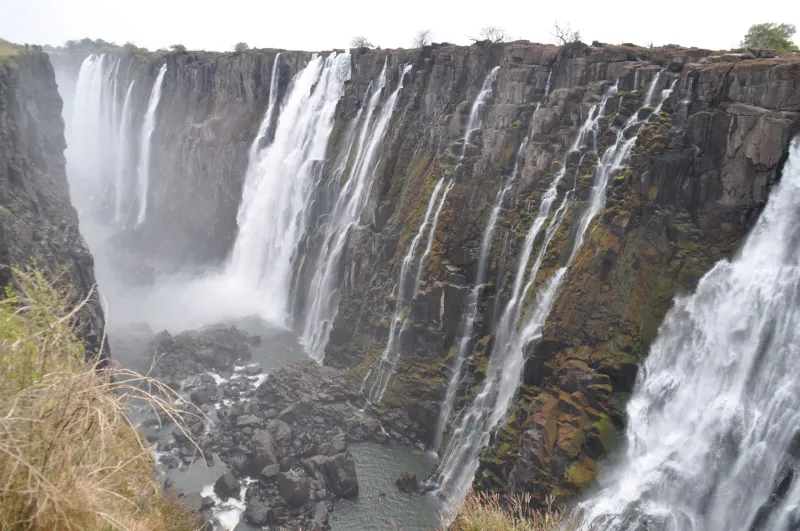
Something happens here. Something that doesn't happen in quite the same way at the Grand Canyon, or Niagara, or even the Amazon. Travelers who visit Mosi-oa-Tunya — the Kololo name for Victoria Falls, meaning "the smoke that thunders" — come back altered. Not always in dramatic, movie-trailer ways. But altered nonetheless.
We wanted to understand why.
The Moment the Noise Stops (By Getting Louder)
Here's the paradox of standing at the edge of Victoria Falls: it is one of the loudest places on Earth, and yet people consistently describe it as the first moment of real quiet they've felt in years.
The roar of 500 million liters of water crashing over a 354-foot drop every minute is genuinely deafening. Your phone vibrates in your pocket and you can't hear it. Notifications, mental to-do lists, the low-grade hum of ambient anxiety that most Americans carry around like a second carry-on — all of it gets drowned out. Not metaphorically. Literally.
Travel therapist Dana Osei, who has worked with clients processing major life transitions, says this kind of sensory override can be genuinely therapeutic. "When the external noise is that overwhelming, the internal noise has nowhere to go," she explains. "People stop ruminating. They stop planning. They just are. And in that gap, a lot of clarity tends to rush in."
For many visitors, that clarity arrives fast and hits hard.
The Resignation Letter Written on a Napkin
Marcus T., a 38-year-old project manager from Atlanta, had been unhappy in his corporate job for the better part of a decade. He'd taken the Victoria Falls trip as a 35th birthday gift to himself — a solo adventure he'd been putting off since college. He wasn't looking for a sign. He wasn't in crisis. He was just, as he puts it, "tired of being tired."
He stood at Knife Edge Bridge on his third morning, watching the mist rise off the gorge below, and made a decision he'd been circling for years. He pulled out a notebook from his daypack and started writing down what he actually wanted his life to look like. Not what made sense on paper. Not what his parents had hoped for. What he wanted.
Six weeks after returning home, he'd given notice at his job and enrolled in a culinary program. He now runs a small catering company in Decatur.
"I know it sounds like a cliché," he says. "But I genuinely think I needed to stand somewhere that big to realize how small my fear was."
Marcus is not an outlier.
What the Psychology Actually Says
There's a concept in environmental psychology called awe — a specific emotional response triggered by encounters with things that are vast, powerful, and difficult to mentally process. Researchers at UC Berkeley have spent years studying awe's effects on the brain, and the findings are striking.
Experiencing awe reliably reduces self-focused thinking. It makes people feel like a smaller part of a larger whole — which sounds deflating but actually tends to produce the opposite effect. People become more open to new information, more willing to question long-held assumptions, and more likely to report feeling that their problems are manageable.
Victoria Falls, by almost any measure, is an awe-delivery machine. The scale of it — the width, the drop, the mist cloud visible from 30 miles away, the sound that seems to come from inside the earth — hits every trigger researchers have identified. You don't have to be spiritual to feel it. You just have to show up.
"The Falls have a way of putting things in perspective that no therapy session or meditation app has ever matched for me," says Priya S., a repeat visitor from Chicago who has made the trip three times in seven years. "The first time I went, I was going through a divorce. I wasn't expecting anything except distraction. What I got was — I don't know — permission, maybe. Permission to start over."
Why Zambia's Side Makes It More Personal
It matters, too, where you stand. Zambia's side of the Falls offers something the more heavily trafficked Zimbabwe side doesn't always provide: space. Room to breathe. Room to sit with whatever the Falls is stirring up in you without being jostled by a crowd.
The national park on the Zambian side — Mosi-oa-Tunya National Park — wraps the experience in something quieter and more immersive. You can walk paths through the rainforest that flanks the gorge, sit at viewpoints that feel genuinely private, and take your time without the pressure of moving through a tourist conveyor belt.
That space matters enormously when what you're processing is big.
Many visitors describe long, unplanned walks along the gorge where they end up working through decisions they'd been avoiding for months. Something about the physical movement combined with the proximity to all that raw power seems to unlock a kind of thinking that's hard to access at home.
The Repeat Visitor Phenomenon
One of the more telling patterns in the Victoria Falls travel community is how many people come back. Not once more, but repeatedly — often at major life junctures.
Priya's three visits each corresponded to a significant crossroads: divorce, a career shift, and most recently, deciding whether to move across the country. "I know it sounds like I use the Falls as a crutch," she laughs. "But honestly? It works every time. I come back knowing what I need to do."
This isn't unusual. Tour operators on the Zambian side will tell you that a meaningful percentage of their bookings come from returning visitors. People who found something here and came back to find it again.
What to Expect If You Go Looking for Clarity
Here's the honest truth: you can't manufacture a Victoria Falls revelation. You can't schedule one for Tuesday at 2pm between the sunset cruise and dinner. The Falls don't work on demand.
What you can do is create the conditions for something to happen. That means slowing down. Building unscheduled time into your itinerary. Putting the phone away — not just in your pocket, but genuinely away. Spending time at the Falls in the early morning, when the light is soft and the crowds are thin. Taking the slower walk instead of the fast one.
It means letting yourself be uncomfortable with the size of it, instead of immediately reaching for your camera.
And it means being honest with yourself about what you're carrying when you arrive. Most people who report transformative experiences at Victoria Falls weren't empty when they got there — they were full. Full of questions they hadn't let themselves ask, decisions they'd been deferring, lives that had quietly drifted from what they actually wanted.
The Falls don't give you the answers. They give you the nerve to admit you already know them.
One Week That Changes the Math
A week at Victoria Falls is not a long vacation by any objective measure. But travelers consistently describe it as disproportionately impactful — more clarifying, more restorative, and more directionally significant than trips that lasted far longer.
Maybe it's the awe. Maybe it's the distance from ordinary life. Maybe it's something the Kololo people understood when they named this place "the smoke that thunders" — an acknowledgment that what happens here is not ordinary, not quiet, and not something you simply walk away from unchanged.
Whatever it is, the pattern holds. People come to Victoria Falls for the adventure, the beauty, the bucket-list checkmark. And they leave with something harder to photograph but far more valuable.
Themselves, a little more clearly.