Why the Air at Victoria Falls Feels Alive — The Science Behind One of Earth's Most Extraordinary Microclimates
You'll notice it before you even see the falls. The temperature drops, the air thickens with moisture, and somewhere ahead of you a curtain of mist rises so high it looks like low-hanging cloud. Most visitors chalk this up to being near a big waterfall. Fair enough. But what's actually happening here is something far more fascinating — and far more fragile — than it might appear.
Victoria Falls doesn't just produce spectacular scenery. It manufactures its own weather. And that manufactured weather sustains an entire living world that exists nowhere else on Earth.
What Makes a Microclimate — and Why Victoria Falls Has One of the Best
A microclimate is essentially a localized atmospheric zone where conditions differ significantly from the surrounding area. Deserts can have microclimates inside canyon walls. Cities generate heat microclimates compared to surrounding suburbs. But Victoria Falls produces something on a different scale altogether.
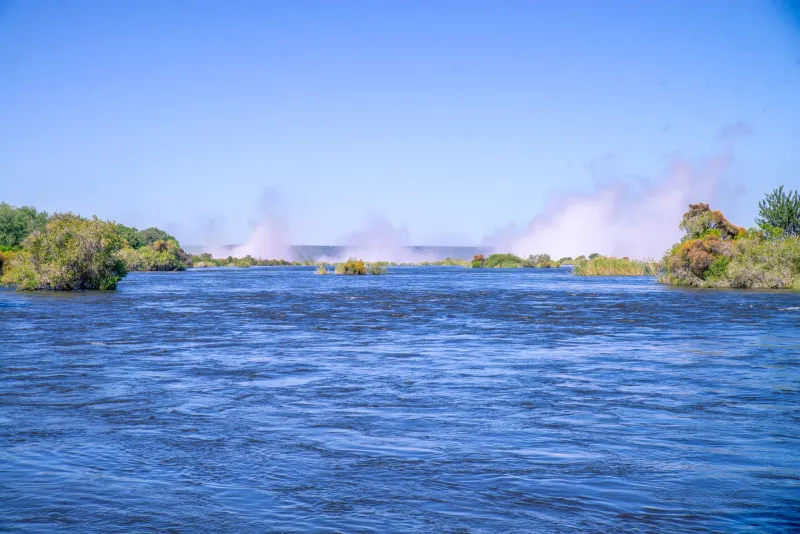
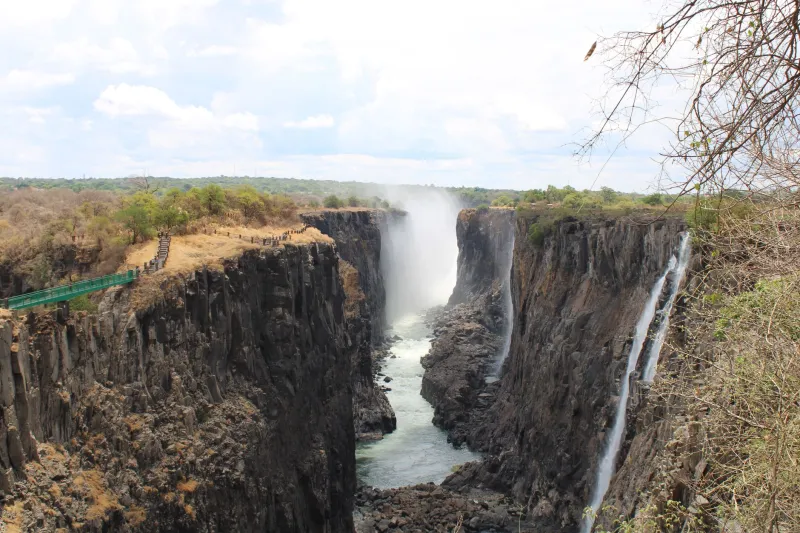
The Zambezi River channels roughly 1.7 billion gallons of water over the falls every minute during peak flow. That staggering volume crashes into the gorge below and atomizes into a fine mist that rises hundreds of feet into the air, visible from over 30 miles away. This perpetual spray saturates the immediate environment in moisture, keeping temperatures noticeably cooler than the surrounding Zambian savanna — sometimes by 10 degrees Fahrenheit or more. Humidity near the falls can approach 100% year-round, even during Zambia's dry season when the rest of the landscape turns brittle and brown.
The result is a ribbon of lush, permanently wet habitat threading through an otherwise semi-arid region. Scientists call it a "rain forest island" — and that description barely does it justice.
A Rainforest That Built Itself
The forest lining the Zambian side of the falls didn't grow here because of good soil or favorable geography in the traditional sense. It grew here because the falls told it to.
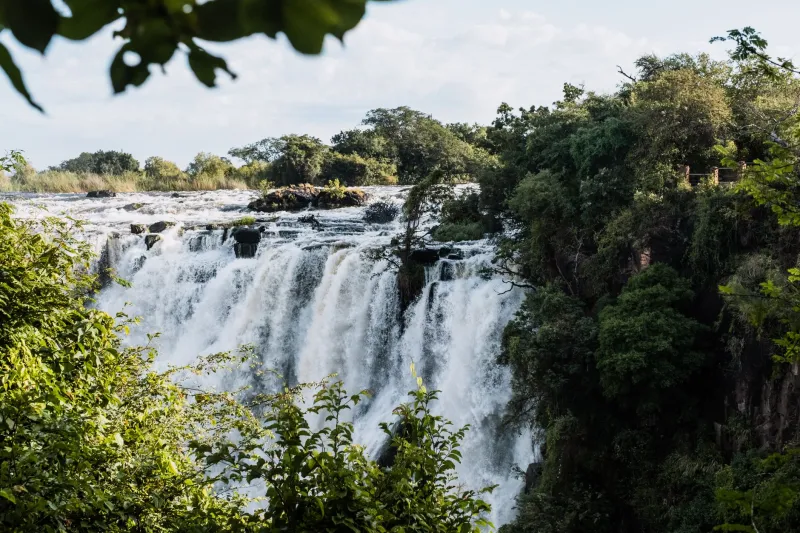
Centuries of continuous spray have drenched the canyon rim in moisture, allowing plant species typically found in equatorial rainforests to establish themselves deep inside southern Africa. Fig trees, wild date palms, ebony, and mahogany crowd the pathways. Ferns and mosses plaster every rock surface. Flowering plants bloom in the understory even in July, when most of Zambia is parched.
For American visitors used to thinking of Africa as a land of open savannas and dry bush, this corridor of dense, dripping vegetation comes as a genuine surprise. It feels less like Zambia and more like something you'd expect to find in the Pacific Northwest or the rainforests of the Olympic Peninsula — except you're standing 50 yards from one of the world's great natural wonders.
What's particularly remarkable is that this ecosystem is almost entirely self-sustaining. The falls create the moisture, the moisture sustains the forest, the forest stabilizes the soil, and the soil feeds the forest. It's a closed loop of ecological generosity.
The Birds That Only Show Up Here
If you've packed binoculars, this is where they earn their spot in your bag.
The microclimate around Victoria Falls draws bird species that have no business being this far south in Africa. The African finfoot, a secretive and rarely seen waterbird, haunts the quieter channels near the falls. Trumpeter hornbills nest in the tall fig trees, their calls echoing off the gorge walls in a sound that's equal parts prehistoric and theatrical. Böhm's bee-eaters — iridescent green and rust-colored, almost impossibly beautiful — dart through the spray-zone vegetation catching insects disturbed by the mist.
What makes birding here special isn't just the diversity. It's the concentration. Because this forest island is isolated from similar habitat by miles of dry bush in every direction, birds that depend on dense, wet forest have nowhere else to go. The falls become a refuge, and patient visitors are rewarded with sightings that would be considered exceptional anywhere else in the region.
The spray zone also attracts raptors. African hawk-eagles and Verreaux's eagles ride the thermal columns rising from the gorge, scanning for prey flushed out by the constant disturbance of the water. Standing at a viewpoint and watching an eagle hang motionless above the mist — with the roar of the falls in the background — is one of those travel moments that doesn't need a filter.
What Conservationists Are Watching
For all its apparent power, this ecosystem is more vulnerable than it looks.
Climate variability poses the most immediate threat. During drought years, the Zambezi's flow drops significantly, reducing the spray and shrinking the effective reach of the microclimate. During those periods, the outer edges of the spray-dependent forest begin to dry out. Some plant species retreat. Certain bird populations thin. Scientists monitoring the area have documented these fluctuations with increasing concern as regional rainfall patterns grow less predictable.
Tourism pressure is the other side of the equation. The pathways through the rainforest on the Zambian side are carefully managed, but foot traffic — especially during peak season — compacts soil and stresses root systems near the trail edges. Zambia's Department of National Parks and Wildlife, along with several conservation NGOs operating in the region, actively monitors vegetation health and works to ensure that visitor access doesn't outpace the forest's ability to recover.
For travelers, this is worth knowing — not to feel guilty about visiting, but to understand why staying on marked trails and following guide instructions actually matters here. You're not just following rules. You're participating in the active preservation of something irreplaceable.
How to Experience This Differently
Most visitors to Victoria Falls spend their time chasing the big views — and those views absolutely deserve chasing. But slowing down inside the rainforest corridor changes the experience completely.
Walk the trails on the Zambian side during the early morning, when the light filters through the canopy and the mist catches it in ways that make the whole forest glow. Stop and listen. The sound environment shifts dramatically as you move closer to the falls — the white noise of the water, the drip of condensation from leaves, the calls of birds hidden in the understory. Bring a light rain jacket, because the spray will soak you regardless of what the sky is doing.
If you're traveling with kids, the microclimate angle is genuinely one of the best hooks for getting them engaged. The idea that a waterfall can create its own rainforest — its own weather, its own species — tends to land with younger visitors in a way that pure scale and spectacle sometimes doesn't.
For nature-focused travelers, asking your guide specifically about the ecology of the spray zone is always worth doing. Many of the local guides working the Zambian side have deep knowledge of the plant and bird species present and can point out things you'd walk right past on your own.
The Falls as a Living System
Victoria Falls is easy to reduce to superlatives. Widest curtain of falling water in the world. Loudest natural sound in Africa. Most dramatic single viewpoint on the continent. All of those things are true, and none of them are wrong reasons to visit.
But the microclimate reframes the falls as something beyond a geological spectacle. It's an active, breathing system — one that has been quietly building and sustaining life for thousands of years, long before anyone named it or photographed it or built a hotel nearby.
When you walk into that mist and feel the temperature shift and hear the forest close around you, you're not just experiencing a waterfall. You're stepping inside an ecosystem that the falls themselves created. That's a different kind of wonder — and it's one worth carrying home with you.