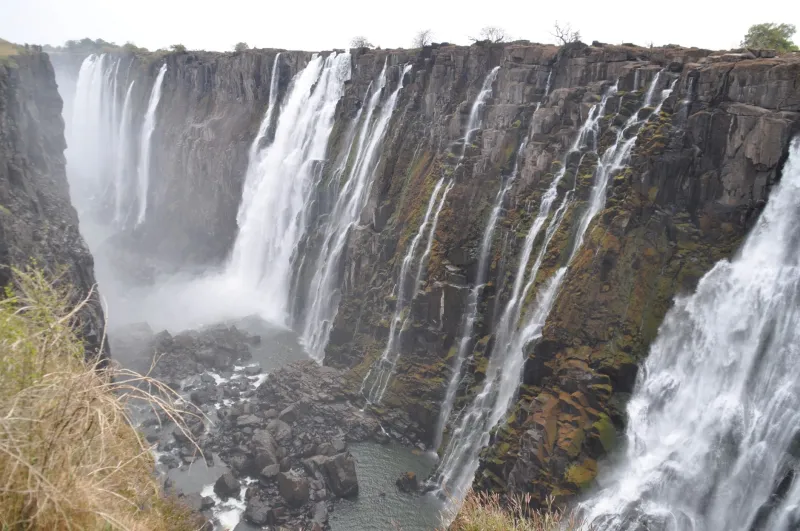
Your Favorite Park Has a Rival: What Happens When Yellowstone Devotees Meet Mosi-oa-Tunya

Photo: Diego Delso, CC BY-SA 4.0, via Wikimedia Commons
Let's be honest with each other: if you're the kind of American who plans vacations around Junior Ranger badges and has strong opinions about the best entrance to Grand Teton, you already have the skill set for Zambia. You just might not know it yet.
Mosi-oa-Tunya National Park — that's the name on the paperwork, though most people just call it Victoria Falls — is Zambia's answer to the parks you grew up with. And while it covers a fraction of the acreage (we're talking roughly 25 square kilometers versus Yellowstone's 3,471 square miles), what it packs into that small footprint will genuinely rearrange your expectations.
Same Instincts, Different Soundtrack
Here's the thing about national park people: we love the feeling of a park. The hush before a geyser blows. The way everyone in the car goes quiet when an elk steps into the road. Mosi-oa-Tunya delivers that feeling, but the soundtrack is completely different.
Instead of the hiss and rumble of geothermal features, your baseline audio here is the permanent, low-frequency thunder of the world's largest sheet of falling water. Locals named it for it — Mosi-oa-Tunya means "the smoke that thunders" — and once you hear it, you'll understand why no one bothered with a catchier name. It's audible from miles away, and it never stops. Yellowstone's geysers perform on schedule; this thing is on all day, every day, and has been for roughly 100,000 years.
The sensory palette flips in other ways too. Instead of the sharp pine-and-sulfur smell of Yellowstone's basins, you get warm mineral air and the constant cool mist drifting off the Falls, which sustains a genuine rainforest right on the park's edge. In August. In a country where everything else is savanna. It's the kind of ecological plot twist that makes rangers here grin when they explain it.
Wildlife Encounters Without the Traffic Jam
Anyone who's idled for forty minutes in Yellowstone's Lamar Valley waiting for a wolf to twitch knows the deal with American wildlife viewing: patience, long lenses, and a lot of hope.
Mosi-oa-Tunya flips the script. Because the park is compact and the animals are accustomed to low-impact tourism, your sightings come faster and closer — ethically closer, managed by rangers who've been doing this their whole careers. White rhino, one of the park's crown jewels, are tracked and protected around the clock, and ranger-led walking experiences let you observe them on foot with a trained guide. If you've never stood a few respectful meters from a two-ton animal while a ranger calmly explains its social life, it's a core memory waiting to happen. Think of it as the difference between watching a documentary and being in one.
Elephants move through the park and across the Zambezi at will. Hippos hold their positions in the river like bouncers. Giraffe, zebra, buffalo, and a truly absurd variety of birds round out the roster. And because the park borders the town of Livingstone, you can literally have a morning game drive and be back at your lodge for lunch — something nobody has ever said about Yellowstone.
Rangers Who Want to Talk to You
One underrated similarity between the systems: both countries run on rangers who genuinely love these places. But the Zambian model leans harder into personal connection. Group sizes on guided walks are small by design, and your guide will know individual animals by history, not just species. Ask them anything — about anti-poaching work, about how the park weathered the pandemic's tourism drought, about why the rhino here are among the most protected animals on Earth. They'll tell you, and it'll stick with you longer than any overlook sign.
That's the real pitch for the Yellowstone-to-Zambia pipeline: you already believe parks matter. You already get that entrance fees fund conservation. Zambia just lets you see that loop working up close, in a park small enough that your visit visibly supports it.
A Different Kind of Scale
Here's the mental shift to pack alongside your sunscreen. American parks awe you with vastness — you drive for hours and barely scratch the map. Mosi-oa-Tunya awes you with intensity. The Falls alone are nearly twice the height of Niagara and more than a kilometer wide, dumping hundreds of millions of liters per minute at peak flow. There is no vista point that contains it. The mist column can rise 400 meters and be visible from 50 kilometers away.
Your national park instincts will still serve you well: arrive early, hydrate, respect wildlife distances, talk to the rangers, leave no trace. Bring those habits across the equator and Mosi-oa-Tunya will feel less like a foreign country and more like your favorite park's louder, warmer, wilder sibling.
Old Faithful will always have a piece of your heart. But the smoke that thunders? It's calling, and it doesn't do reservations — just show up.