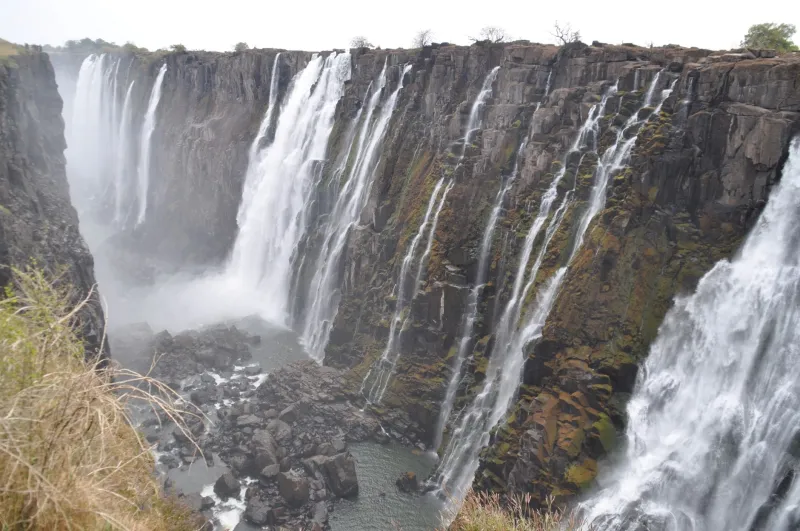
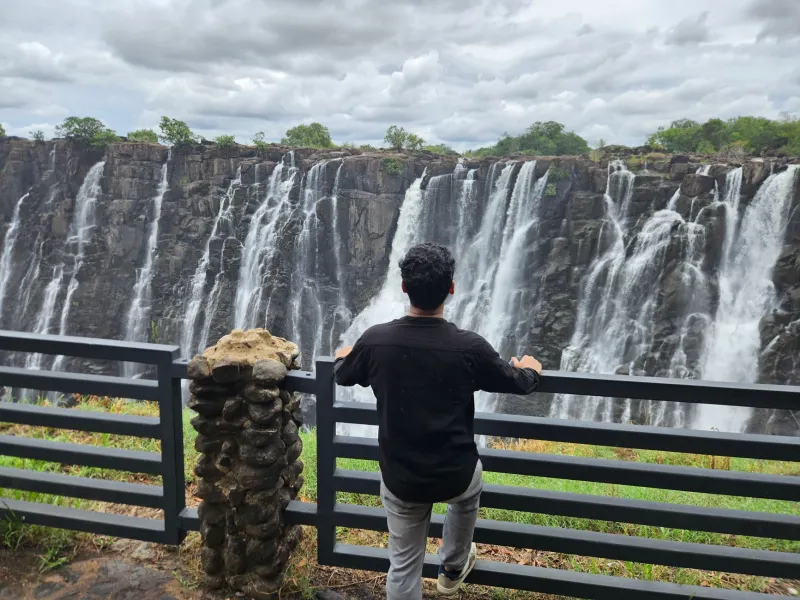
Mist on the Canvas: The Forgotten Artists Who Found Their Voice at Victoria Falls
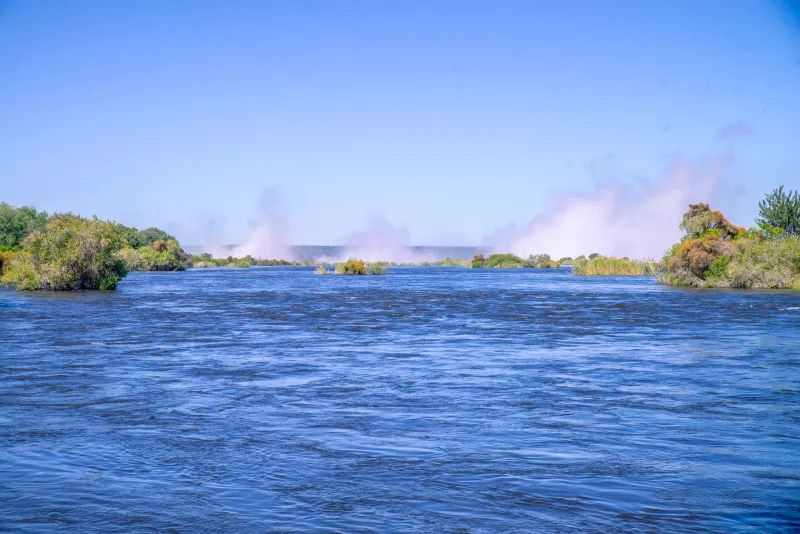
Every great natural wonder collects its famous admirers. Victoria Falls has Livingstone's journals, the colonial-era engravings, the glossy wildlife documentaries. But underneath the well-documented awe of the famous visitors runs a deeper, stranger current — a lineage of lesser-known painters, composers, poets, and musicians who came to the Falls, got swallowed whole by what they experienced, and made work that most of the world has never seen.
These are some of their stories.
The Composer Who Recorded Thunder
In the early 1970s, a South African sound artist named Elias Dlamini made a journey to the Zambian side of the Falls with a reel-to-reel tape recorder, a battered notebook, and what he later described as "a need to hear something bigger than music."
Dlamini had been working in Johannesburg's emerging jazz scene, frustrated by what he felt was the genre's increasing commercialization. He wasn't sure what he was looking for. He found it in the roar.
He spent four days camped near the Falls, recording at different hours — the pre-dawn quiet when the mist settles differently, the midday thunder, the strange acoustic pocket you find at the Boiling Pot where the gorge walls redirect the sound into something almost melodic. He returned with hours of tape.
The compositions he built from those recordings — layering mbira, bass clarinet, and processed field recordings — were performed exactly twice in Johannesburg before he moved to London. They were never commercially released. A handful of cassette copies circulated through the South African expat music community in the early 1980s, and a small archive of his work now sits in a private collection in Cape Town.
Musicians who have heard the recordings describe them as "the sound of something that doesn't have a name yet."
The Painter Who Kept Getting It Wrong
Miriam Osei was a Ghanaian painter studying in the United Kingdom when she took a detour through Zambia in 1988 during what was supposed to be a research trip focused on East African textile traditions. She wasn't planning to stop at Victoria Falls. A fellow traveler on a bus persuaded her.
She ended up staying for three weeks.
"The problem with the Falls," she wrote in a letter to her sister, later published in a small collection of her correspondence, "is that it is never the same thing twice. I paint what I see in the morning and by afternoon it is a lie. The light changes. The mist moves. The color of the water is not a color I have ever mixed."
Osei eventually abandoned her attempts to paint the Falls directly. Instead, she began painting the effects of the Falls on the surrounding landscape — the way the spray nourishes a narrow band of rainforest in an otherwise dryer environment, the particular green of leaves that have never known drought, the iridescent quality of a spider's web in permanent mist.
This shift in approach — from the overwhelming subject to its quieter consequences — defined the rest of her career. Her work, which commands serious attention in West African contemporary art circles, almost never depicts water directly. "The Falls taught me to look sideways," she told an interviewer in 2004.
The Novelist Who Threw Away Her Draft
Amanda Perkins was a mid-career American novelist — two moderately successful literary novels, a teaching position at a university in the Pacific Northwest — when she received a fellowship that took her to southern Africa in 2011. She arrived at Victoria Falls with 200 pages of a third novel she'd been fighting with for three years.
"I thought I'd finish it there," she says. "I thought the change of scenery would unstick me."
What actually happened was that she walked to the Falls on her second morning, stood in the spray at the main viewpoint on the Zambia side, and realized with sudden, uncomfortable clarity that the novel she'd been writing was dishonest. Not factually — emotionally. She had been writing around the true center of the story for three years because the true center scared her.
She deleted the 200 pages from her laptop that evening. She started over from a different point of view, a different voice, a different wound. The novel she eventually published in 2015 was shortlisted for a significant literary prize. In interviews, she rarely mentions Victoria Falls. But in the book's acknowledgments, there's a single line: "For the Zambezi, which knows when you're lying."
The Poet the Internet Found Late
Nyambe Sikaonga was a Zambian poet who worked most of his life as a secondary school teacher in Livingstone, the town that sits at Victoria Falls' doorstep. He published two slim collections of poetry in the 1990s through a small Lusaka press, both of which sold a few hundred copies and disappeared.
Sikaonga wrote almost exclusively about the Falls — not as spectacle, but as neighbor. His poems treat Mosi-oa-Tunya (the Smoke That Thunders, the Falls' Lozi name) as a presence that has opinions, moods, and a long memory. In one of his best-known poems, the Falls speaks directly to a traveler who has arrived with a camera and no patience:
You have come to take a piece of me home.
I have been here since before your country had a name.
Stand still. I am not in a hurry.
Neither, now, are you.
Sikaonga died in 2009. A decade later, a literature professor in Nairobi posted a photograph of one of his poems on social media. It went quietly viral in African literary circles, then spread. His out-of-print collections now sell for significant sums when they surface online. A Zambian publisher reissued his work in 2022.
He never knew any of this was coming. He just kept writing about the water.
What the Falls Does to Creative People
There's a pattern across these stories that's hard to ignore. The Falls doesn't seem to inspire artists in the way we typically imagine inspiration working — a sudden gift of an idea, a bolt of creative lightning. Instead, it seems to function as a disruptor. It breaks things open. It makes the dishonest draft feel unbearable. It makes the safe creative choice feel like a waste of time.
Maybe that's what happens when you spend time with something that has been relentlessly, unstoppably itself for hundreds of thousands of years. The pretense starts to feel expensive.
If you're a creative person planning a trip to Victoria Falls, bring your work. Bring the draft that isn't working, the project you've been circling, the idea you're not sure you're good enough to pull off. Spend some time at the water's edge with it.
The Falls has strong opinions about what's worth keeping.